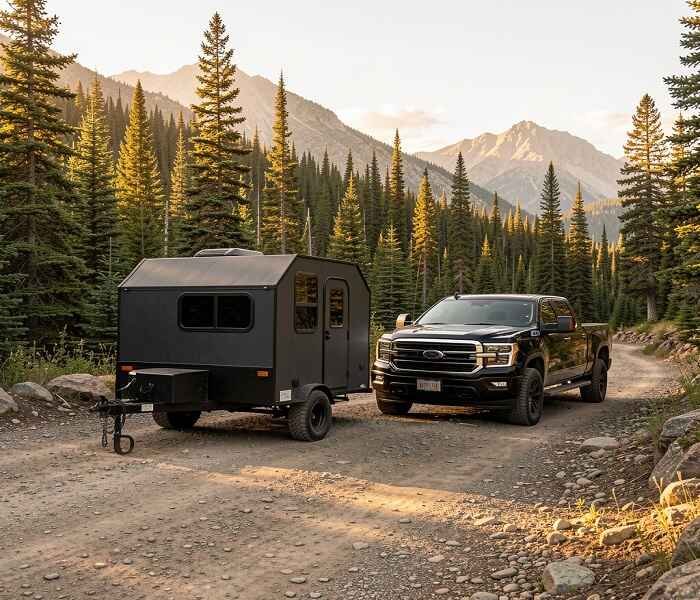
Hiker Trailer is a US-made, fully customizable square drop camper available in five models ranging from $4,999 to $16,999 at base. It is designed for outdoor enthusiasts who want lightweight, off-road capable shelter without the cost or complexity of a full RV.
Most people start their camper search looking at full RVs. Then they see the price tag. Then they consider a van build. Then they see what that actually costs. Somewhere in that process, Hiker Trailer shows up, and it tends to stay.
It is not the flashiest option. It does not have a showroom in every city or a slick dealership experience. What it has is a straightforward build, genuine off-road capability at a price most alternatives cannot touch, and thousands of owners who went looking for something better and stopped looking once they found it.
This guide covers the full picture, every model with real pricing (not just the number they advertise), what comes standard, how the customization process actually works, how the trailer holds up based on real owner experience, and where it falls short. Everything you need to decide whether this is the right trailer for how you camp.
Pricing and specifications in this guide are based on publicly available information from the manufacturer’s website and independent owner reviews at the time of writing. Always verify current pricing directly with Hiker Trailer before making any purchase decisions, as figures are subject to change.
What Is a Hiker Trailer?
Hiker Trailer is a square drop camper, a rectangular take on the classic teardrop trailer design. The front section is a sleeping cabin, the rear opens as an outdoor galley kitchen. Every unit is hand-built to order in Columbus, Indiana, so no two trailers are identical.
The company has over ten years in business with more than 4,000 units on the road. Steel frame, aluminum exterior, light enough for a mid-size SUV to tow, capable enough for unpaved roads. It sits between tent camping and a full RV in both cost and complexity, which is exactly the gap it was designed to fill.
Hiker Trailer Models — All Five Explained
Understanding the full model range matters because the right choice depends entirely on where you camp and what you tow with. Here is what each model is and who it suits.
The Highway Lite starts at $4,999. Built for paved roads and standard campsites, the lightest, most affordable entry point for first-time trailer buyers who want to experience the format before committing to more capability or cost.
The Highway Deluxe runs from $6,299 to $8,299 depending on size, available in 5×8, 5×9, and 5×10 feet. Handles paved roads, gravel, and packed dirt on a 2,000lb axle with 14-inch wheels. Average price once built out with customizations: $11,104.
The Mid Range is Hiker’s most popular model, priced from $8,699 to $10,699. Steps up to a 3,500lb torsion axle, 29-inch tires, and a 17-inch hitch height, capable on rocky paths, open fields, and moderate off-road terrain. Average as-built price: $15,056.
The Mid Range XL adds a 2-inch integrated lift kit and 32-inch tires to the Mid Range foundation. Prices run $10,999 to $11,999. The 20-inch hitch height opens up moderate to heavy off-roading. Average as-built: $19,479.
The Extreme Off Road is the flagship, priced from $14,999 to $16,999 at base, with an average as-built of $23,914. Leaf spring suspension with shocks, 33-inch tires, 22-inch hitch height, built-in rock sliders, integrated frame storage racks, two front stabilizer jacks. Goes wherever the tow vehicle goes.
Real Budget: Base Price vs What You Will Actually Pay
The base price on every model is genuine, but the gap between that number and what most buyers actually spend is worth understanding before the configurator opens.
The Highway Deluxe starts at $6,299. The average buyer pays $11,104. On the Extreme Off Road, the gap between base and average as-built stretches to nearly $9,000. That pattern holds across the entire lineup.
What drives those numbers: awnings ($800–$1,100), electrical packages including solar and battery ($500–$1,200), extra doors and screen doors ($350–$800), water tank and pump ($890), climate control options ($600–$1,500), and cargo additions like roof racks and toolboxes ($400–$1,000+).
Most of these can be added after delivery. The modular design means the configuration is not locked in at purchase — starting lean and building over time is a legitimate approach for budget-conscious buyers.
Standard Features on Every Model
Every Hiker Trailer ships with the same base package regardless of which model you choose.
Exterior: four aluminum color options with black trim, solid side door with locks, rear galley door with locks, two operable side windows with screens, manual roof vent, LED marker and brake lights, 2-inch ball hitch, and a 110V exterior shore power plug.
Interior: rear galley with two shelves 17 inches deep, pass-through access between galley and cabin, front cabin cubbies with 12V wiring and USB, 110V power strip in the galley, dome light, galley light, interior fuse block, and vinyl flooring throughout.
Functional and road-ready. Nothing beyond that, which is exactly the point.
Customization Options
The configurator spans hundreds of combinations. Knowing the categories before you open it helps.
Exterior additions include 270-degree awnings or standard side awnings, a second door, screen door, two-bar or three-bar roof racks, fridge box mount, exterior flood lighting, and a 23Zero shower room that attaches directly to the trailer wall.
Interior options cover additional front and rear cabinet builds, extra shelving with doors to keep items from shifting on rough roads, mattress upgrades, pass-through window doors between galley and cabin, and lighting additions including reading lights and overhead strips.
On power, most builds come pre-wired for solar. Battery placement is a choice between tongue and rear galley, and the system works with portable stations like the Jackery Explorer 1000 or EcoFlow Delta without modification needed.
Climate options include the MaxxFan roof vent, rooftop AC for hot-climate use, diesel heater integration for winter, and additional side vents for cross-ventilation.
Off-road and towing additions cover electric brakes, an autobrake controller, a lock-and-roll articulating hitch — owners consistently rate this among the most worthwhile upgrades — spare tire with mount, and the rear receiver hitch that comes standard on every model.
Which Tow Vehicle Do You Need?
The Highway Lite and Highway Deluxe sit at 800 to 1,000 pounds dry. Most mid-size crossovers and SUVs — RAV4, CR-V, Ford Escape — handle these comfortably. Always calculate loaded weight including water and gear against your vehicle’s tow rating, not just the dry trailer figure.
The Mid Range reaches 1,000 to 1,200 pounds dry and climbs further once loaded. A mid-size truck like the Tacoma or Ranger, or a larger SUV like the 4Runner, is the practical minimum. Smaller crossovers can manage but will feel the strain on grades and during braking.
The Mid Range XL pushes to 1,200 to 1,300 pounds dry — full-size truck territory. F-150, Ram 1500, Silverado 1500.
The Extreme Off Road starts at 1,350 pounds dry with a 216-pound tongue weight. A full-size truck is the baseline at this level, not an upgrade. Running it with an undersized vehicle undermines what the trailer was built for.
Across all models: stay at least 20 percent below your vehicle’s rated tow capacity using fully loaded weight. That margin keeps braking distances safe and reduces sway at highway speeds.
Build Quality — The Honest Assessment
The construction is steel frame, plywood body, aluminum exterior skin. Some owners have described it plainly as a plywood box with thin sheet metal covering — and that is accurate. It is not a criticism, it is a description, and understanding it sets the right expectations.
What makes the build smarter than it sounds is how the aluminum attaches. It is mechanically fastened rather than glued, which allows natural expansion and contraction with temperature changes. Glued aluminum delaminates over time — Hiker’s approach avoids that failure mode entirely.
Real-world durability holds up under serious use. One owner documented over 16,000 miles including genuinely rough terrain without structural problems. Outside Online tested the Extreme Off Road for four months on backcountry roads and described it as holding up without issues even after hard use.
The consistent maintenance item is sealant. Seams around windows and the roof vent degrade with sustained UV exposure and heavy use — annual inspection and resealing is standard ownership maintenance. Ignore it and water intrusion follows.
No insulation comes in the standard build. This is a three-season shelter as delivered. Buyers who plan winter trips without factoring this in are the ones who leave frustrated reviews — not because the trailer failed, but because the expectation was not accurate going in.
Ordering Process — How It Actually Works
Hiker Trailer does not operate on a dealership model. There is no lot to browse and drive off the same day.
The process starts at hikertrailers.com with the online configurator — choose model, size, and work through add-on categories with pricing updating in real time. For buyers who need faster delivery, a selection of ready-built units is listed on the site, pre-configured and sometimes priced slightly below the equivalent custom order.
A deposit locks in the order and pricing once the build is finalized. Lead times on custom builds vary with demand — historically anywhere from a few months to over a year during peak periods. Current timelines are best confirmed directly with the company before committing.
Pickup is from Columbus, Indiana. Delivery is available at additional cost. Hiker Trailer appears at RV shows across the US throughout the year, attending one before ordering is worth it if geography allows, since the physical trailer answers questions that no configurator or review fully can.For a closer look at how direct-builder purchasing works, the Mike’s Pretty Good Campers buying guide covers it well.
Year-Round Camping — What It Actually Takes
The standard trailer handles three seasons without modification. Winter and sustained heat require specific planning.
For summer, the MaxxFan combined with the two side windows manages most nights adequately. In consistently hot climates where temperatures push well above 90 degrees regularly, the rooftop AC is easier to add at order time than to retrofit later.
Winter use requires addressing the insulation gap. The standard build has none, meaning cold transfers through the walls quickly. Owners who camp through winter typically use one of two approaches: a Chinese diesel heater routed through an existing vent opening is the most common — inexpensive and effective in sustained cold. The factory heater add-on is the integrated alternative at higher cost. Condensation in cold weather is managed by running the MaxxFan on its lowest setting overnight.
Outside Online noted after extended testing that the trailer is not suited for genuine four-season use without aftermarket insulation work. Owner reports confirm this consistently.
Power Setup — Three Approaches
Shore power comes standard on every model via a 110V exterior plug. At campgrounds with hookups, this covers all needs without additional equipment.
For off-hookup weekend trips, most Hiker owners use a portable battery station. The EcoFlow Delta and Jackery Explorer 1000 appear most frequently in owner discussions — either handles lights, the MaxxFan, and device charging across a full weekend without recharging. Cost runs $500 to $1,000 depending on capacity, and no installation is needed.
For extended off-grid use, a roof-mounted solar panel paired with a lithium battery bank in the tongue or rear galley is the practical solution. Most builds come pre-wired for solar input, making this addition straightforward at order time or after delivery. A functional system costs $1,500 to $3,000 depending on panel wattage and battery capacity.
What Real Owners Say
Praise across independent reviews and owner forums is consistent: build quality holds up under real use including serious off-road conditions, the customization process is genuinely flexible, customer service is noted positively across multiple independent sources, and resale value stays strong. Owners also frequently mention that having a trailer that stays permanently packed changes how often they actually get out — the low-friction setup makes trips happen that would otherwise not.
The complaints are equally consistent. Delivery timelines extend longer than some buyers expect, and communication during the build has been flagged as falling short in several reviews. The inability to stand up inside catches new owners off guard — it is a square drop format characteristic, not Hiker-specific, but without experience in a similar trailer it surprises people. Sealant maintenance comes up regularly as something buyers wish had been explained at purchase. The limited dealer network means most post-purchase issues require DIY resolution or coordinating a shipment back to Indiana.
Owner experiences shared here are drawn from publicly available reviews, forums, and independent testing at the time of research. Individual experiences may vary.
Hiker Trailer vs The Alternatives
Timberleaf Teardrops run roughly 20 to 30 percent above comparable Hiker models. Better factory insulation and a more premium interior are the differences. For buyers who need genuine four-season capability without aftermarket work, Timberleaf addresses that directly at higher cost.
The Boreas X1 is built for serious backcountry access and offers less interior living space. It suits a narrower buyer profile and is priced similarly at the base level. The use case is more specific.
Lightweight tent trailers and folding camp trailers start under $3,000 but trade away hard sides, weather resistance, and durability. For occasional mild-weather camping they serve a purpose. For regular use across varied terrain and conditions, the durability difference is significant enough to change the comparison. If you are weighing other handbuilt compact options in the same category, Mike’s Pretty Good Campers is worth a look.
Is a Hiker Trailer Right for You?
It works well for solo travelers and couples who prioritize reaching remote locations over interior space, camp frequently enough to benefit from gear that stays ready, and are working with a budget between $5,000 and $25,000.
It is a harder fit for families who need more sleeping room, anyone for whom standing room inside is non-negotiable, buyers who want a built-in stove, sink, and running water as part of the standard package, people who need a local dealer for service and support, and four-season campers not willing to add aftermarket heating and insulation.
FAQ
How much does a Hiker Trailer cost?
Base prices run from $4,999 for the Highway Lite to $16,999 for the Extreme Off Road. Average as-built prices range from $11,104 to $23,914 depending on model and options added.
Who owns Hiker Trailer?
Rob Reeve, operating out of Columbus, Indiana.
How wide is a Hiker Trailer?
The Highway Deluxe is 80 inches wide. The Mid Range and Mid Range XL run 82 to 84 inches. The Extreme Off Road is 87 inches.
Are Hiker Trailers waterproof?
The aluminum exterior handles rain well. Seals around windows and the roof vent require annual inspection —sealant degradation from UV exposure is a known maintenance item across the lineup.
How long is the wait for a custom build?
Lead times vary with demand. Historically from a few months to over a year during peak periods. Ready-built units are available for faster delivery. Confirm current timelines directly with the company.
Can I tow a Hiker Trailer with an SUV?
The Highway Lite and Highway Deluxe are compatible with most mid-size SUVs and crossovers. The Mid Range and above are better matched to mid-size or full-size trucks. Verify against your specific vehicle’s rated tow capacity using fully loaded weight, not the trailer’s dry weight.
Final Verdict
Hiker Trailer occupies a genuine space in the market, more capable than cheap tent trailers, more affordable than premium teardrop brands, and more customizable than either. The construction is functional rather than premium and holds up well under real use with proper maintenance. The modular build means the configuration is never truly locked in, which works in favor of buyers who want to start within a tighter budget and add over time.
The trade-offs are real: no standing room, no factory insulation, build timelines that require patience, and a support structure that puts most post-purchase responsibility on the owner. These are not hidden problems, they are the natural result of what this type of trailer is and what it costs. For buyers who go in understanding them, the value is hard to argue with.