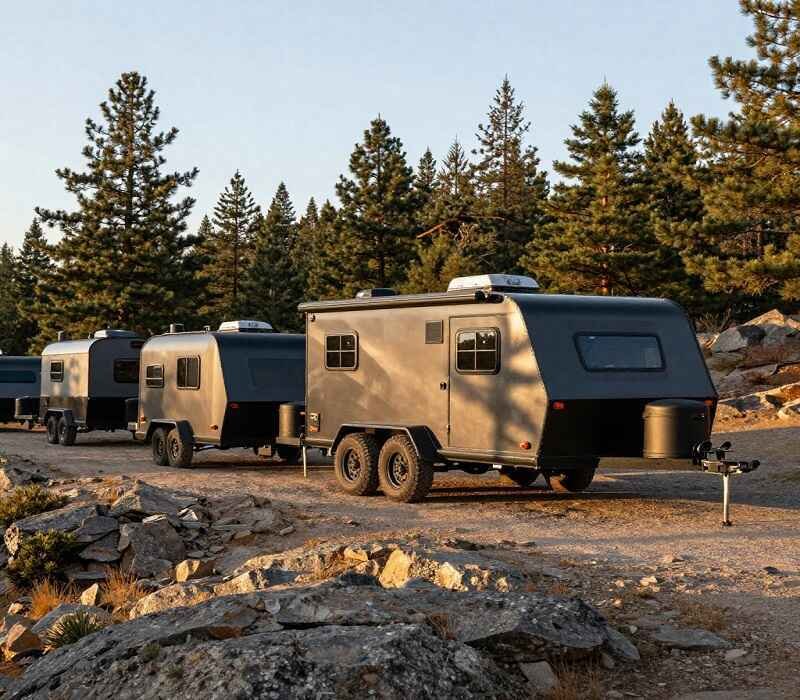
Five hiker trailer models, one right answer for your situation. The Mid Range is where most buyers land. The right one for you depends on your tow vehicle and where you actually camp.
Picking the wrong hiker trailer model is an expensive mistake — and it happens more often than it should because most comparisons stop at price. This guide goes deeper. Every model is broken down by what it is actually built to do, who it genuinely fits, and what real owners say after using it. By the end you will know exactly which one makes sense for your setup.
The Five Hiker Trailer Models — Quick Overview
Hiker Trailer builds five models and each one is genuinely different from the next — not just in price but in what it is built to do. The Highway Lite and Highway Deluxe are on-road and light gravel trailers. The Mid Range is where moderate off-road capability starts. The Mid Range XL steps that up with a lift and bigger tires. The Extreme Off Road is purpose-built for terrain that rules out everything else.
Every model is hand-built to order in Columbus, Indiana. The body is plywood covered with aluminum exterior panels, no insulation standard, and no two units come out identical because every buyer configures theirs differently. Base prices are the starting point — most buyers spend significantly more once they build it out the way they actually want it.
Highway Lite — Who It Is Actually For
The Highway Lite is $4,999 flat and it is the only hiker trailer model with a single fixed price. No size choices, no base upgrade path. It is lightweight, comes with brakes standard, and has the lowest tow requirement of the entire lineup.
People upgrading from tent camping who just want a dry, comfortable place to sleep without any off-road ambitions tend to land here. If your vehicle has a modest tow rating or you want the simplest possible setup, this is where Hiker starts. What it is not is a trail runner — it is built for paved roads and maintained campgrounds. If there is any chance you will want to go further than that, the next model up is worth the extra cost.
Highway Deluxe — The Most Misunderstood Model
The Highway Deluxe runs $6,299 to $8,299 and is the model most people overlook because it sits in an awkward middle ground. It is more capable than the Lite but not off-road capable the way the Mid Range is, which pushes buyers to either step down to save money or step up for the extra capability.
What makes it worth considering is tow vehicle fit. Owners have confirmed towing it comfortably with a RAV4, Subaru Outback, Crosstrek, and even an AWD Sienna. If your vehicle has a tow limit under 2,000 pounds, the Highway Deluxe is often the only hiker trailer model that fits within a safe margin once the trailer is loaded with gear.
Watch the weight creep though. One owner with a 5×10 Highway Deluxe reported a max gross of 2,200 pounds and found themselves at 1,850 pounds fully loaded for a two-night trip — only 350 pounds under the limit. The model stands about 65 inches tall, which also makes it the most garage-friendly option in the lineup.
Mid Range — Why Most People End Up Here
The Mid Range starts at $8,699 to $10,699 and is Hiker’s most popular model by a wide margin. It is the first hiker trailer model with torsion suspension, a 3,500-pound axle, and a welded rear 2-inch receiver hitch — which together mean it can handle trails, rough paths, and open fields rather than just smooth roads.
Owners towing with a Ford Edge, mid-size SUV, or mid-size truck find it fits comfortably within their vehicle’s capability. A queen mattress fits well in the 5×9 and owners at 5’11” report sleeping comfortably without feeling cramped. The model stands around 67.5 inches tall, and with a 270-degree awning at its highest position it clears just under 78 inches — worth measuring against any low garage or covered parking.
The Mid Range is also where the customization options really open up. Deeper galley shelves, fridge box, water system, full electrical setup — all of it fits properly here in a way the Highway models do not support as cleanly. Most owners who went Mid Range say they would not go back.
Mid Range XL — The Sweet Spot for Off-Road
The Mid Range XL starts at $9,999 for the 5×9 and $11,999 for the 5×10. It builds on the Mid Range with a factory-integrated 2-inch lift kit and larger tires, giving it meaningfully more ground clearance without moving to the Extreme Off Road price point.
For buyers who want genuine off-road capability but are not planning to tackle expedition-level terrain, this is often the smartest place to land among all the hiker trailer models. A well-configured 5×9 XL currently lists as a ready-built unit at $13,748 — which gives a realistic picture of where a solid build lands in real life. The lift and tires handle rocky approaches and rutted forest roads with noticeably more confidence than the standard Mid Range, and the total build cost stays more manageable than the Extreme Off Road.
Extreme Off Road — When You Actually Need It
The Extreme Off Road runs $14,999 to $16,999 at base and is the most purpose-built model in the hiker trailer lineup. Hiker describes it as limited only by the tow vehicle, and that is accurate — it is genuinely built for terrain the other models cannot handle.
The listed base weight and the real as-built weight diverge more on this model than any other. Owners who have fully optioned an Extreme Off Road have reported real dry weights approaching 2,500 pounds — on a trailer listed at a much lower base figure. If your tow vehicle has a rated capacity under 3,500 pounds, the Extreme Off Road deserves serious scrutiny before you order it. A full-size truck is the baseline here, not a mid-size SUV.
Outside Magazine tested a fully configured Extreme Off Road at $14,359 at a time when competing off-road teardrops started at around $20,000 at base. That value gap still exists. For buyers who genuinely need this level of capability and have the tow vehicle to match it, nothing else in the lineup comes close.
Size Guide — 5×8, 5×9, or 5×10?
Most hiker trailer models come in multiple sizes and the size choice matters as much as the model choice. Owners who got this wrong almost universally say they wish they had gone bigger.
The 5×8 fits a queen mattress wall to wall with no floor space left over. A 6-foot couple with two dogs described it as cozy but workable — a polite way of saying it is tight. It works for solo campers but there is zero room for anything else inside.
The 5×9 is where most buyers land. A queen fits properly with space at the foot for boots, a bag, or a dog bed. Owners at 5’11” report sleeping comfortably with room to spare. For most couples this is the right call. The 5×10 is the move for anyone 6 feet or taller, anyone planning extended trips, or anyone who wants real storage inside the cabin. If you are going back and forth between the two, go with the 5×10.
Which Hiker Trailer Model Should You Actually Buy?
This comes down to two things — your tow vehicle and where you actually camp. Everything else follows from there.
If your vehicle tops out around 2,000 pounds towing capacity, the Highway Deluxe is your ceiling. It works well for campgrounds and light gravel — just watch the weight as you add options. If you have a mid-size truck or larger SUV and camp on trails or rough roads, the Mid Range is the baseline. Most buyers who land here say they would not go smaller. If you want more off-road confidence without the Extreme Off Road price, the Mid Range XL is the answer. The Extreme Off Road is for one specific buyer — full-size truck, genuinely remote terrain. If that is not you, the Mid Range XL gives you most of what you actually need.
FAQ
How many Hiker Trailer models are there?
Five — Highway Lite, Highway Deluxe, Mid Range, Mid Range XL, and Extreme Off Road. Each is built for a different use case and price point.
Which Hiker Trailer model is most popular?
The Mid Range. First model with genuine off-road capability and the broadest customization options.
What size Hiker Trailer should I get?
For most couples the 5×9 is the right call. If you are 6 feet or taller or want extra storage, go 5×10. The 5×8 works for solo campers but feels tight for two people with any gear.
Can I tow a Hiker Trailer with a small SUV?
The Highway Lite and Highway Deluxe are confirmed towable with a RAV4, Outback, Crosstrek, and AWD Sienna. Mid Range and above need a mid-size truck or larger.
What is the cheapest Hiker Trailer model?
The Highway Lite at $4,999 flat.
How tall are Hiker Trailer models?
Highway Deluxe stands around 65 inches. Mid Range is about 67.5 inches. With a 270-degree awning at its highest position the Mid Range clears just under 78 inches.
Final Verdict
The hiker trailer models are genuinely different from each other and picking the wrong one is an expensive mistake. Most buyers who do their research land on the Mid Range or Mid Range XL — and most of them are happy with that call years later.
If your tow vehicle decides it for you, let it. Do not stretch your vehicle’s capacity to get a model it cannot safely pull. Go one size bigger on the trailer dimensions than you think you need, and pick the model that matches where you actually camp.
For a full breakdown of what everything costs once you build it out, see our Hiker Trailer cost guide.
Model specs and pricing are based on manufacturer listings and verified owner data at the time of writing. Confirm current specs and pricing directly with Hiker Trailer before placing an order.