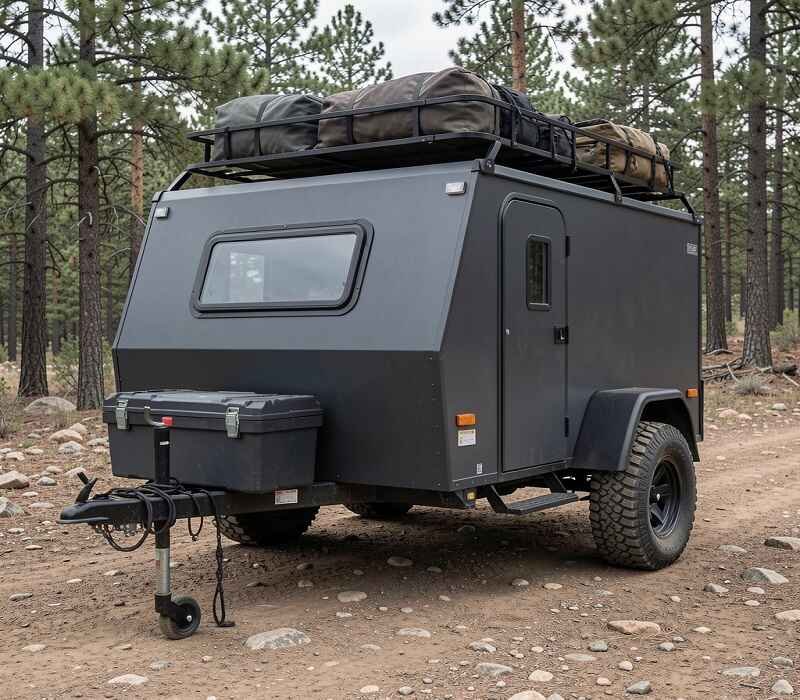
A Hiker Trailer is good value for frequent campers who want off-road access and a permanently organized rig. The main limitations are no standing room, no insulation standard, and long build times.
Most pros and cons lists for a Hiker Trailer read like they were written by someone who has never owned one. This one is not that. Everything here comes from verified owner accounts, real build data, and documented field use — so you get an honest picture of what you are signing up for before the deposit clears.
What You Are Actually Getting — The Basics First
A Hiker Trailer is a compact square-drop camper with a sleeping area in the front and an open galley kitchen in the rear. It is not an RV, not a tent, and not a van. It is a purpose-built sleeping and gear setup designed for people who want to reach places most campers cannot and show up with a real bed waiting for them.
Every unit is hand-built to order in Columbus, Indiana. The body is plywood covered with thin aluminum panels that are mechanically fastened rather than glued, which means the exterior can expand and contract without adhesive failure over time. There is no insulation in the base models and no standing room in any model. Those are deliberate choices that keep the trailer lightweight, simple, and towable by a wide range of vehicles. Understanding that upfront is what separates buyers who are happy with their Hiker Trailer from buyers who wish they had bought something else.
The Pros — What Hiker Trailer Gets Right
The price is the most obvious advantage and it is a real one. Competing off-road teardrops from other builders start at around $20,000 at base. A fully configured Extreme Off Road tested by Outside Magazine came in at $14,359 — below where most competitors even begin. At the Mid Range level a well-built unit lands around $14,000 to $16,000. That gap is significant and it is not explained by corners being cut on the things that matter most.
Customization is the second major pro. Every trailer is built to order and the options list is extensive — awnings, solar systems, fridge boxes, water tanks, extra doors, flood lights, roof racks, heaters, and more. One verified owner built a Mid Range Deluxe 10-foot with over $8,000 in options and described it as the most usable camping setup she had ever owned.
The simplicity of the build is underrated. Fewer systems mean fewer things to break. No plumbing lines to freeze, no slide-outs to jam, no complex electrical baked into the base unit. One verified owner put 16,000 miles on her Mid Range Deluxe across two years of year-round camping — Southern Utah, Yosemite, Grand Teton, the San Juan Mountains — and reported only one minor issue the entire time.
Resale value is stronger than most comparable trailers. Used units typically list at 85 to 90 percent of new equivalent pricing in good condition, and well-optioned units sometimes list above their original purchase price. For a trailer in this price range that retention is unusual.
The Cons — Where It Falls Short
No standing room is the most consistently mentioned con. You sleep in it, store gear in it, and cook outside it. If you want a space to stand up or hang out inside when the weather turns, a Hiker Trailer is not that — and it cannot be made into that.
No insulation in the base models is the second real limitation. The walls are about an inch thick — plywood and aluminum with nothing between them. A verified owner made winter camping work by rigging a diesel heater with aluminum ducting through an added vent, but that is a DIY solution on a trailer that does not come ready for cold weather. If you camp in temperatures that drop regularly below freezing, budget for a heating solution from day one.
Build times run 14 to 18 weeks during peak season. You are not walking into a dealership and driving one home. And quality control at delivery is inconsistent enough that owners strongly recommend a thorough inspection before leaving the lot. Documented issues have included loose roof rack screws, incorrectly mounted components, and minor plumbing errors that needed fixing before first use.
Weight creep catches buyers off guard. A fully loaded 5×9 Highway Deluxe with gear for a two-night trip came in at 1,800 pounds for one owner — leaving only 350 pounds of margin against their vehicle’s max gross. Buyers who configure without tracking the total weight carefully can end up over their tow vehicle’s safe limit before they realize it.
The Trade-Offs Nobody Talks About
There is a difference between a con and a trade-off. A con is something that should be better. A trade-off is a deliberate design choice that costs something in one area to deliver something in another.
Fuel economy takes a hit with any trailer. The Highway Deluxe adds about 0.8 mpg loss compared to driving unloaded. The Mid Range adds around 1.4 mpg. The Extreme Off Road adds approximately 2.2 mpg. These numbers add up on long trips and belong in any honest hiker trailer pros and cons conversation.
The modular ownership approach is something most buyers do not know about going in but end up appreciating. You do not have to configure everything at the factory.
Pre-wiring for solar and buying the battery and panels yourself later is a common and smart move — you keep the clean factory installation without paying Hiker’s markup on the hardware. Shelves and cabinetry can also be added after the fact. Starting simpler and building out over time is a real option, and it changes how the upfront cost feels.
The Extreme Off Road at real as-built weights approaching 2,500 pounds dry needs a full-size truck. Not a mid-size SUV, not a large crossover. Buyers who want that model but own a mid-size truck are not in a grey zone — that is a hard mismatch worth knowing before falling in love with the top model.
Who a Hiker Trailer Makes Sense For
The clearest fit is someone who camps frequently and wants a setup that is always ready to go. One verified owner described leaving her trailer packed and ready in the driveway — which changed how often she actually went camping because the prep work was already done. For frequent campers that convenience is a real quality-of-life change.
Active campers who want off-road access without paying premium expedition trailer prices are the core audience. The Mid Range and above genuinely handle trails, fire roads, and rough terrain that stops a conventional camper. For buyers who want to reach dispersed sites and backcountry access points at a price that is still significantly below comparable builds from other brands, Hiker makes a strong case.
For a full comparison of all five models and which one fits your tow vehicle and camping style, see our Hiker Trailer models guide.
Who Should Look Elsewhere
If you want to stand up inside, cook in a covered kitchen, or have somewhere to sit when it rains, a Hiker Trailer is not the right fit. A small travel trailer or camper van will serve those needs better.
If you camp occasionally — a few times a year at established campgrounds — the cost is hard to justify. A rooftop tent or basic camper shell delivers a similar experience at a fraction of the price for low-frequency use. If you need a trailer quickly, the 14 to 18 week build time is a genuine barrier. And if your vehicle has a tow rating under 1,500 pounds, the options become very limited even at the entry level.
FAQ
What are the biggest pros of a Hiker Trailer?
Price, customization, off-road capability, and simplicity. It is the most affordable US-made custom off-road compact trailer in the category.
What are the biggest cons of a Hiker Trailer?
No standing room, no insulation standard, long build times, and inconsistent quality control at delivery.
Is a Hiker Trailer good for winter camping?
Not out of the box. Owners who want year-round use add a diesel heater with ducting — it works well but is a separate cost and setup.
Does a Hiker Trailer affect fuel economy?
Yes. Highway Deluxe adds about 0.8 mpg loss, Mid Range around 1.4 mpg, and Extreme Off Road approximately 2.2 mpg.
How long does it take to get a Hiker Trailer?
Build times run 14 to 18 weeks during peak season. Ready-built units are available for faster pickup but come in fixed configurations.
Is the quality good?
Long-term structural quality is solid — verified owners report 16,000+ miles with no frame or body issues. Delivery quality is inconsistent and a careful inspection at pickup is strongly recommended.
Final Verdict
The hiker trailer pros and cons come down to one question — do you camp enough and in the right places for this to make sense? If yes, the value case is genuinely strong. Affordable, customizable, simple enough to stay reliable, and capable enough to get you places most campers cannot reach.
If not — if you camp occasionally, want to stand up inside, or need something ready in a few weeks — there are better options for your situation. The buyers who are happiest with their Hiker Trailers went in knowing exactly what it is and what it is not. They planned for the weight, inspected at pickup, and use it often enough that the cost per trip makes the whole thing feel like a smart call.
Information in this article is based on verified owner accounts and manufacturer data at the time of writing. Confirm current specs and pricing directly with Hiker Trailer before placing an order.