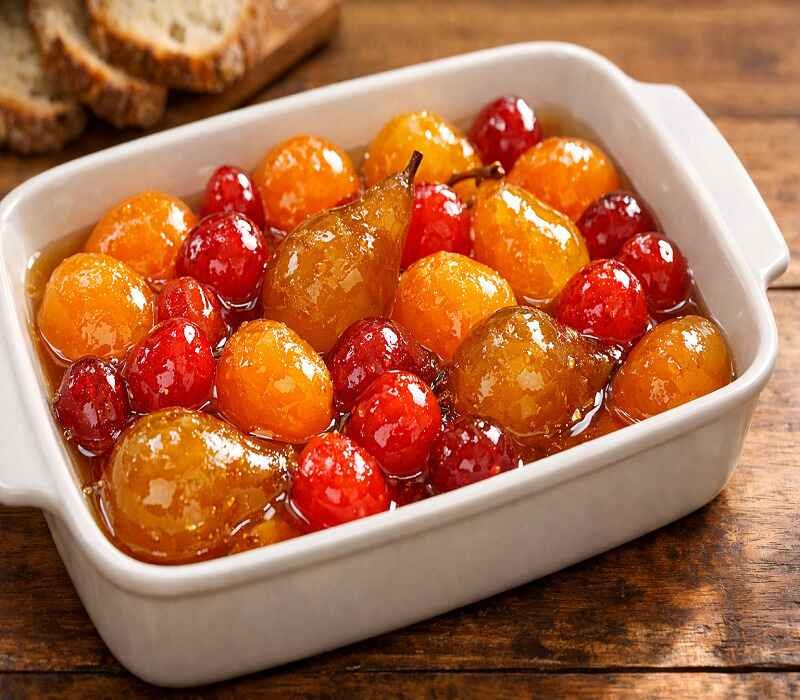
Mostarda is a northern Italian condiment made from candied fruit preserved in a clear syrup infused with mustard essence — sweet, sharp, and nothing like regular mustard. It has been a staple of northern Italian tables since the 16th century, traditionally served with boiled meats and aged cheeses.
Mostarda is not mustard. Most people assume it is, Google it, get confused and give up — which means they never find out what it actually is. That is a shame, because it is one of the best condiments Italy ever produced.
It is candied fruit in a mustard-spiked syrup — sweet upfront, then a sharp nasal heat that disappears almost as fast as it arrives. The kind of thing that makes you stop mid-bite and ask what you just ate. This article covers everything: what it is, where it comes from, how to make it, and where to buy the real thing.
Mustard essence is highly concentrated and should be handled carefully in a well-ventilated area — keep it away from your face and skin. When in doubt, dry mustard powder dissolved in white wine is a safer substitute.
The History of Mostarda
Mostarda is older than most people realize. The Romans were already making something close to it — they combined grape must with ground mustard seeds to create a spiced, pungent condiment they called mustum ardens, which simply means “burning must.” That Latin phrase is where the word mostarda actually comes from, and it tells you everything about what this condiment was always meant to be: fruit and heat, together.
During the Middle Ages, apothecaries across northern Italy kept the tradition alive by preserving fruit in mustard-infused syrups. It was practical as much as it was delicious — sugar and mustard both helped extend the shelf life of fruit through harsh winters. The condiment slowly moved from pharmacy shelves to noble tables.
The earliest written record that connects mostarda to royalty comes from 1397, when Gian Galeazzo Visconti, the Duke of Milan, personally wrote to the mayor of Voghera requesting a large jar of candied mustard fruit for his Christmas table. That single letter is one of the clearest signs that by the late 14th century, mostarda was already considered a luxury worth asking for by name.
By the 16th century, Cremona had claimed mostarda as its own. The city’s version — built around whole, mixed candied fruits in a sharp mustard syrup — became so well-known that the first documented recipe specifically named after Cremona appeared in a 1604 Belgian cookbook. Cremona reportedly helped its own reputation by gifting mostarda to Spanish rulers of Milan at Christmas, and word spread fast from there.
Regional Varieties of Mostarda
Mostarda is not one thing — it changes completely depending on where in Italy you are. The version you try in Cremona will look and taste nothing like what you find in Mantova or Sicily, and that variety is exactly what makes it so interesting.
Mostarda di Cremona is the one most people outside Italy have seen. It uses large chunks of mixed whole fruit — pears, cherries, figs, apricots, oranges, peaches — all candied and held in a sharp, transparent mustard syrup. The fruit stays intact, the syrup is heavy with mustard essence, and the heat hits you fast. This is the version you will find at most Italian delis and specialty stores abroad.
Mostarda di Mantova takes a completely different approach. It is made from mele campanine — small, tart green apples native to that area — sliced thin, candied, and flavored with mustard. The texture is softer and the flavor more delicate than Cremona’s version. Interestingly, it is also a key ingredient in pumpkin tortelli, the famous stuffed pasta from Mantova.
The Vicenza style moves even further from what you might expect. Here, quince is cooked down into a puree, then mixed with diced candied fruit — the result is smooth and spreadable rather than chunky. It looks more like a thick jam than a preserve.
Piedmont’s version is called Cougnà in local dialect. It skips mustard seeds entirely and is made instead from grape must — typically Barbera or Fragolino — cooked slowly with quince, pears, and toasted hazelnuts. You will often see it served alongside aged mountain cheeses like Castelmagno or Robiola.
Sicily’s mostarda, known locally as mustata ri vinu cottu, has nothing in common with the northern versions beyond the name. It appears during the autumn grape harvest and is made from cooked grape must thickened with flour into a soft, jelly-like shape. Some versions swap in prickly pear instead of grapes. No mustard seeds, no syrup — just fruit, must, and spice.
Ingredients and Flavor Profile
Mostarda has three core components: fruit, sugar syrup, and mustard essence. The fruit is candied — cooked slowly in a sugar-and-water syrup until it becomes translucent, soft on the inside, and firm enough to hold its shape. Common choices are pears, cherries, apricots, figs, peaches, and citrus, though this varies by region and season.
The mustard element is where things get interesting. Authentic Italian mostarda uses mustard essence — a highly concentrated oil extracted from mustard seeds. You only need a few drops per kilogram of fruit, and even that tiny amount delivers serious heat. Outside Italy it is almost impossible to find, so most home cooks substitute dry mustard powder dissolved in warm white wine, which works well but produces a slightly cloudier syrup.
When you taste mostarda, the first thing that hits you is sweetness — the candied fruit and syrup are genuinely sugary. Then, almost immediately, a sharp nasal heat kicks in from the mustard essence. It is not the slow burn you get from chili — it is closer to the eye-watering sharpness of fresh horseradish or wasabi, there one moment and gone the next, leaving warmth and the lingering flavor of the fruit behind.
That contrast is exactly the point. The sweetness and the heat are not fighting each other — they are working together. A good mostarda is never just spicy, and it is never just sweet. The balance between the two is what makes it useful alongside rich, fatty foods like boiled meats and aged cheese, where you need something that cuts through rather than adds more heaviness.
How Mostarda Is Made
Making mostarda at home takes four days. The actual time you spend doing anything is under an hour total — the rest is just waiting. The process is built around a slow, repeated reduction that concentrates the syrup and pulls flavor deep into the fruit.
Day One: Macerate the Fruit
Peel and cut your chosen fruit into medium-sized chunks and place them in a bowl. Cover completely with sugar and leave for 24 hours. The sugar draws out the natural juices, creating a pooled liquid at the bottom of the bowl by next morning.
Day Two and Three: Build the Syrup
Drain the liquid into a saucepan, bring to a boil, reduce for five minutes, then pour back over the fruit. Rest for 24 hours. Repeat on day three. Each cycle thickens the syrup and pushes flavor deeper into the fruit without cooking it to mush.
Day Four: Finish and Bottle
Bring the fruit and all its syrup into a wide pan and simmer together for ten minutes. Pull off the heat and cool completely — mustard goes in only once cooled, never into hot liquid as heat kills its bite. Pack into sterilized glass jars and seal.
Classic Mostarda di Cremona Recipe
The Cremona version is the one most people outside Italy recognize — whole or large-chunk mixed fruit in a clear, sharp mustard syrup. Here is how to make it at home.
Ingredients
2 pounds mixed firm fruit — figs, pears, apricots, cherries — cut into large even chunks. 1½ cups sugar. Juice of half a lemon. 1 to 2 tablespoons dry mustard powder dissolved in 2 tablespoons warm white wine — or 10 to 15 drops mustard essence per kilogram of cooked fruit if you can source it.
Method
Toss the fruit with sugar and lemon juice and leave uncovered at room temperature for 24 hours. Follow the four-day process described above. On the final day, once the fruit has cooled completely after its last simmer, stir in the mustard. Mustard essence produces a cleaner, sharper heat and keeps the syrup transparent — dry mustard works well but turns the syrup slightly cloudy.
Pack into sterilized jars and refrigerate. Waiting 48 hours before opening lets the heat distribute evenly — the difference between a good mostarda and a great one.
What to Eat With Mostarda
Mostarda was made for bollito misto — a northern Italian dish where different cuts of meat are slow-boiled in broth until tender, then served with a selection of sharp, bright condiments alongside. Mostarda is always one of them. The sweetness of the candied fruit and the heat of the mustard cut straight through the richness of the boiled meat in a way that no other sauce quite manages.
Cheese is the other natural home for mostarda. Aged hard cheeses like Parmigiano Reggiano and Pecorino work especially well because the saltiness and crystalline texture of the cheese stand up to the syrupy intensity of the condiment. Gorgonzola dolce is another strong pairing — the sweetness of mostarda against the pungency of the blue creates a contrast that works immediately. The one cheese to avoid is sharp cheddar, which tends to clash rather than complement.
On a charcuterie board, a small bowl of mostarda placed next to prosciutto, mortadella, and salami transforms the entire spread. A thin slice of prosciutto with just a touch of mostarda on top is one of those combinations that sounds simple and tastes unreasonably good.
Beyond the classics, mostarda works well as a glaze brushed over pork chops or duck in the last few minutes of roasting. You can also stir a spoonful into a pan sauce after searing meat to add depth without much effort. If you are putting together a cheese board and want one condiment that does everything, mostarda is the answer.
Mostarda vs Mustard vs Chutney
These three get mixed up constantly, and the confusion is understandable — similar names, similar colors, similar uses at the table. But they are built differently and come from completely different culinary traditions.
| Mostarda | Mustard | Chutney | |
|---|---|---|---|
| Origin | Northern Italy | Europe (France, England) | India |
| Base | Candied whole fruit | Ground mustard seeds | Cooked-down fruit/vegetables |
| Texture | Chunky, clear syrup | Smooth paste | Soft, jammy |
| Heat Source | Mustard essence/oil | Mustard seeds | Dried chilies, spices |
| Flavor | Sweet then sharp nasal heat | Tangy, sharp | Sweet, sour, warmly spiced |
| Best With | Boiled meats, aged cheese, charcuterie | Sandwiches, hot dogs | Mild proteins, Indian food |
If you are trying to decide which one to reach for, think about what you are eating. Mostarda belongs next to a slow-cooked roast, a slab of Parmigiano, or a charcuterie board — somewhere the sharpness does real work. If you came here looking for the Croatian version, read our full guide on Muštarda.
Where to Buy Mostarda
If you are in Italy, the best mostarda you will find is in Cremona itself — local delicatessens and specialty food shops carry fresh, house-made versions that commercial products simply cannot match. The Christmas season is when fresh mostarda is most widely available across northern Italy, and buying it directly from a Cremonese producer is worth the effort if you ever find yourself there.
Outside Italy, your best options in the US are specialty Italian grocers. Di Palo’s Fine Foods and D. Coluccio and Sons in New York City both carry authentic versions, and Eataly locations across the country stock Luccini’s Classic Cremona Mostarda in both 8.5oz and 13.4oz jars. For the Mantova style, Casa Forcello — founded by Paola Calciolari and rooted in the traditional recipe she made with her grandmother in Mantova — is one of the better artisan producers available online.
For online orders, Eataly ships nationwide and carries multiple styles including pear mostarda from Le Tamerici and the classic Cremona mixed fruit version. ParmaShop is another reliable source that ships internationally directly from Italy, with customs duties already included in the price.
When buying commercially, check the ingredients list. A good mostarda will list whole or large-cut fruit, sugar, and mustard essence or mustard oil as the main components. If you see a long list of stabilizers, artificial flavors, or a thick uniform texture that looks more like jam than preserved fruit, it is likely a lower-quality imitation.
FAQs
Sweet first, then a sharp nasal heat from the mustard that fades quickly — closer to wasabi than chili. The fruit flavor stays behind after the heat disappears.
Traditionally served with bollito misto and aged cheeses. It also works as a glaze for roasted pork, stirred into pan sauces, or on a charcuterie board.
Chutney is cooked down soft with chili heat. Mostarda keeps the fruit intact in a clear syrup with mustard heat. Different texture, different tradition, different flavor entirely.
No. Mustard is a seed-based paste. Mostarda is candied fruit in a mustard-flavored syrup — they only share a Latin root word.
Unopened, up to a year. Once opened, refrigerate and use within two to four weeks.
Yes — dry mustard powder dissolved in warm white wine works well, though the syrup turns slightly cloudy instead of staying clear.
Pears, cherries, apricots, figs, peaches, quince, and citrus are all common choices. The fruit is candied and preserved in a mus
Mostarda is often called Italian fruit mustard because it combines candied fruit with mustard essence. However, it is very different from regular mustard — the fruit is the main ingredient, not the mustard.
Yes — it works well as a glaze for roasted pork, duck, or chicken. You can also stir it into pan sauces or use it as a spread on sandwiches alongside cured meats.