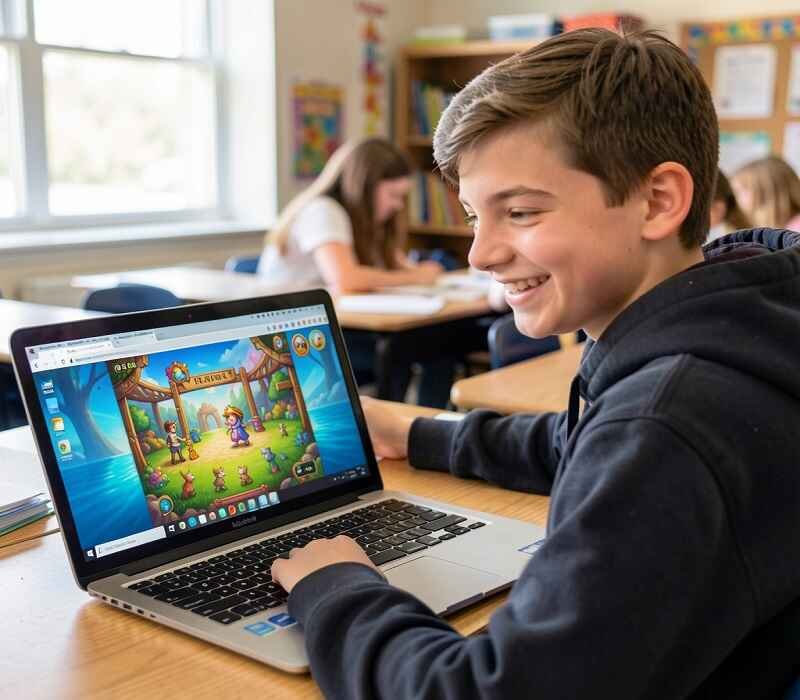
Unbanned G+ refers to browser-based game platforms that stay accessible on school and workplace networks. No downloads, no accounts, no installs — just open a tab and play. The best platforms in 2026 include UnbannedGames.io, GplusGames.com, and ClassroomGames6x.com. Top games include Slope, Run 3, 1v1.LOL, and Retro Bowl.
You are sitting on a school Chromebook with twenty minutes to spare and every gaming site you know is blocked. Sound familiar? That is exactly the problem Unbanned G+ was built around — and the reason students have been passing working links to each other in class chats for years. It is not complicated technology, it is not illegal, and it is not going anywhere. What it is, is browser gaming that actually loads when nothing else does. This guide covers everything — what Unbanned G+ really is, how the platforms stay accessible, which games are worth your time in 2026, how to stay safe, and what separates a real platform from a fake one. Read this once and you will never waste a break on a sketchy site again.
What Is Unbanned G+
Unbanned G+ is not a single website or an official platform. It is a term that students and casual gamers use to describe a collection of browser-based game sites that still load on restricted school and workplace networks. When your school blocks gaming domains, these sites stay accessible because they use alternative hosting methods, rotating domains, and lightweight code that slips past standard content filters.
The name comes from two ideas combined. The “unbanned” part means accessible where games are normally blocked. The “G+” part is a loose reference to Google+, the social platform Google shut down in April 2019, whose name stuck in online culture as shorthand for anything Google-adjacent or community-driven. Over time students started using “G+” to describe game hubs hosted on Google Sites and similar infrastructure, since schools rarely block Google domains outright.
What you actually get with Unbanned G+ is a browser gaming experience that requires no downloads, no accounts, and no installs. You open a tab, the game loads, you play. That simplicity is exactly why it spread the way it did.
Where Did the Name G+ Come From
Google launched Google+ in June 2011 as its answer to Facebook and Twitter. It had Circles, Hangouts, and Communities — features that felt genuinely interesting at the time. But it never found a real audience and Google officially shut it down in April 2019 after a data breach exposed information from around 500,000 accounts.
After the shutdown the G+ name did not disappear — it just changed meaning. Students who hosted game collections on Google Sites started calling them G+ hubs because Google infrastructure was harder for school filters to block. Schools need Google Classroom, Google Docs, and Google Drive — blocking anything Google-domain becomes complicated. That gap is exactly what made G+-style hosting popular for unblocked games.
The “+” stuck because it implied something extra — access where access was not supposed to exist. That is the whole culture behind Unbanned G+ in one symbol.
How Unbanned G+ Works
School and workplace networks block domains by category — gaming, entertainment, social media. Unbanned G+ platforms stay ahead of those filters using a few specific methods worth understanding before you use any of them.
Trusted Domain Hosting
The most reliable Unbanned G+ sites host their games on infrastructure that schools cannot block without breaking other things. Google Sites is the classic example — a school that blocks it also breaks Google Classroom and Google Forms. That conflict keeps Google-hosted game collections accessible longer than sites on standalone gaming domains.
HTML5 Technology
Every game on a legitimate Unbanned G+ platform runs on HTML5. This means games run entirely inside the browser — no Flash, no plugins, no downloads required. Flash was officially retired in December 2020, so any site still asking for a Flash player is either outdated or something you should not click on. HTML5 games load like a webpage and work on any modern browser including Chrome on a Chromebook.
Mirror Sites and Rotating Domains
When a primary domain gets blocked, the same game library often reappears on a new URL within days. Students share updated links through group chats and class channels. Platforms like UnbannedGames.io and Classroom70x.com use this approach — one domain goes down, another comes up. Bookmarking two or three trusted URLs instead of one is the practical response to this.
Lightweight File Sizes
Unbanned G+ games are intentionally small. A Chromebook with limited RAM and a school network with throttled bandwidth can still run Slope or Run 3 without lag because these games are built to be light. Heavy graphics would get flagged or simply time out on restricted networks — lightweight is what makes the whole thing work.
Why Schools and Workplaces Block Games
Schools and workplaces block gaming sites for three reasons that are genuinely reasonable even if they feel frustrating from the other side.
The first is bandwidth. A school network serving hundreds of students cannot afford to have a chunk of that capacity going to game assets during class hours. Even lightweight browser games multiply fast when fifty students are running them at once on the same network.
The second is productivity. Schools have an institutional responsibility to keep students focused during class time. Gaming sites get blocked as a blanket policy — not because the games themselves are harmful but because unrestricted access during lessons is a problem easier to prevent than manage case by case.
The third is security. Not all game sites are clean. Some run aggressive ad networks, some host scripts that try to download things to your device, and some are outright fake copies of real platforms. A school IT department blocking all gaming domains is taking the safest route rather than vetting each site individually. This is also why knowing the difference between a legitimate Unbanned G+ platform and a fake one actually matters.
Best Games on Unbanned G+ in 2026
The game list on Unbanned G+ platforms changes as new titles get added, but a core set has stayed consistently popular for years. These are the ones students actually play.
Slope is the one that started it all for most people. You control a ball rolling down an endless slope at increasing speed and the only goal is not to fall off. It sounds simple until the speed picks up and your brain goes into full focus mode. Short rounds, high replayability, instant to start.
Run 3 is the other evergreen title. You run through a tunnel in space, avoid gaps in the floor, and the tunnel rotates around you. It has an actual progression system with unlockable characters — unusual for an unblocked game — which keeps people coming back longer than a typical one-mechanic title.
1v1.LOL is the most popular multiplayer option. It combines shooting mechanics with building structures, runs entirely in a browser, and lets students play against each other in real time. That competitive real-time element is a big part of why it spread so fast through school networks.
Drift Boss, Moto X3M, Vex 7, Vex 8, and Geometry Dash are the go-to choices for quick action rounds. Retro Bowl scratches the sports itch with a simple American football loop that is genuinely addictive. Basketball Stars is the multiplayer sports pick. Cookie Clicker, 2048, Tiny Fishing, and BitLife sit at the low-intensity end — easy to tab away from quickly, perfect for when a teacher walks by. Snow Rider 3D and Iron Snout 2 are newer additions that have built consistent followings in 2026.
Game Categories Available
Action and arcade games make up the largest chunk — Slope, Moto X3M, Vex 7, Vex 8, and Geometry Dash. Fast, skill-based, short rounds. These are the most shared because the competitive element gives students something to compare and talk about.
Multiplayer games are the second most popular category. 1v1.LOL, Basketball Stars, Paper.io, and Hole.io all support real-time play against other people. Sharing a working link and then competing against classmates is its own social ritual — the person who finds the working site first gets instant credibility in the group chat.
Simulation and strategy games attract a different type of player. Minecraft Classic runs in browser with no account and no download required, which surprises people who assume it needs a launcher. Bloons Tower Defense and Cookie Clicker fit here too — longer sessions, more thinking than reacting.
Casual and idle games round out the selection. Tiny Fishing, 2048, Retro Bowl, and BitLife are low pressure, easy to pause, and none of them punish you for stopping mid-session.
Unbanned G+ on Chromebook
Chromebooks are the most common device in school environments and Unbanned G+ platforms are built in a way that works naturally with them. Every game runs in Chrome, nothing needs to be installed, and the lightweight file sizes mean even older Chromebooks can handle most titles without lag.
The trackpad is the main challenge. Games that need precise mouse movement are harder on a trackpad than a proper mouse. Students who play 1v1.LOL or Krunker.io on a Chromebook regularly suggest zooming the browser out to 90 percent — it gives slightly more screen space and reduces accidental mis-clicks on smaller displays.
Running only one tab at a time is the other consistent advice. School Chromebooks often have limited RAM and multiple open tabs slow everything down noticeably. Close everything else before you start and the game runs at the speed it is supposed to.
Knowing your mute key before the game starts is worth the ten seconds it takes. Most school Chromebooks have a dedicated mute key at the top of the keyboard. Knowing where it is before a game plays audio unexpectedly saves a lot of awkward moments. Platforms confirmed to load well on Chromebooks include UnbannedGames.io, GplusGames.com, ClassroomGames6x.com, and Classroom70x.com.
Benefits of Short Gaming Breaks
There is actual research behind why a short game during a break helps rather than hurts. The brain does not perform well when it stays locked onto the same task for hours without a break. Attention drifts, retention drops, and the quality of work produced in hour three of continuous study is measurably worse than in hour one. A short mental reset between focused sessions helps restore concentration.
Gaming works as a reset because it demands just enough engagement to pull your mind fully away from what you were doing before. Passive activities like staring at a phone do not create the same mental shift. A five to ten minute game that requires real-time reactions gives the prefrontal cortex — the part of the brain responsible for focus — a genuine change of input rather than just reduced input.
The social element matters too. Competing with classmates on 1v1.LOL or comparing Slope scores creates a shared experience that builds connection in a way that scrolling separately on your own phone does not. Students describe this consistently — the link-sharing culture around Unbanned G+ spread naturally because it was social from the start.
The key word is short. A five to fifteen minute session during a designated break is a reset. An hour during class is a problem. The games are not the issue — the timing is everything.
Safety Guide
Not every site that calls itself an Unbanned G+ platform is safe. Some are clean, well-maintained game hubs. Others are fake copies built to serve aggressive ads or trick users into downloading something. Knowing the difference is not complicated once you know what to look for.
Check HTTPS
The address bar is the first thing to check. A legitimate Unbanned G+ site will always show HTTPS at the start of the URL. The padlock icon next to the address confirms the connection is encrypted. If a site loads without HTTPS or your browser shows a security warning, close it immediately.
Never Download
Every real Unbanned G+ game runs entirely in the browser. If a site asks you to download anything — an app, a launcher, a plugin, an update — close the tab. HTML5 games do not require downloads. A prompt asking you to install something is either malware or adware, without exception.
Use an Ad Blocker
uBlock Origin is the most widely recommended free ad blocker and works on Chrome. Installing it on a personal device before visiting any Unbanned G+ platform significantly reduces exposure to aggressive pop-up ads and redirects. School devices usually cannot have extensions installed, which is another reason to stick to the most trusted platforms rather than following random links.
No Personal Info
No legitimate Unbanned G+ platform needs your name, email, phone number, or any account information. These are anonymous, no-login game sites by design. Any site asking you to register or verify anything before playing is not what it claims to be.
Avoid Fake Sites
Fake Unbanned G+ sites copy the look of real platforms and use slightly different URLs — a letter changed, a number added, a different domain extension. The clearest warning signs are fake download buttons styled to look like play buttons, pop-ups claiming your device is infected, and pages that redirect you somewhere unexpected before the game loads. Real platforms load the game directly. If you end up somewhere else after clicking play, close everything and find a different site.
Unbanned G+ vs Other Platforms
Unbanned G+ is not the only option for browser gaming on restricted networks. A few other platforms have been around long enough to build real reputations.
Coolmath Games is the oldest name in this space and the one most likely to already be whitelisted on a school network. It started as an educational math platform which is why school filters often leave it alone. The library leans toward puzzle and logic games — if you want Slope or 1v1.LOL you will not find them here, but if you want something you can open without any risk of it being blocked, Coolmath is the safest starting point.
Poki is a well-designed platform with a large library and cleaner ad practices than most unblocked sites. It loads reliably on many networks and the game quality tends to be higher than average because Poki curates its library rather than hosting everything submitted to it.
Unblocked Games 66 and similar numbered sites have large libraries and minimal curation. Students use them because they always have something rare or new, but they require more caution than Coolmath or Poki. An ad blocker running before visiting is strongly recommended.
CrazyGames sits between Poki and the numbered sites in terms of curation and safety. Solid HTML5 library, loads well on most networks, reasonable ad behavior. Worth bookmarking as a backup.
Students who play regularly tend to keep two or three bookmarks — one safe option like Coolmath, one larger library like Poki or CrazyGames, and one Unbanned G+ specific platform like UnbannedGames.io for the titles those others do not carry.
Common Myths Debunked
A lot of what gets passed around about Unbanned G+ in school hallways is either exaggerated or just wrong.
The first myth is that using Unbanned G+ gets you hacked. Using a legitimate HTTPS-secured platform with no downloads involved carries no more risk than visiting any other website. The risk is real on fake copycat sites — but that is true of the entire internet, not something specific to unblocked games.
The second myth is that schools can see exactly what game you were playing. What a school network typically logs is the domain you visited and roughly when. A student visiting UnbannedGames.io at 12:43pm shows up as a domain visit in the network log — not a detailed session recording. Whether anyone actually looks at those logs varies enormously by school.
The third myth is that Unbanned G+ is illegal. Playing browser-based games on your free period is not illegal anywhere. Accessing a site the school has blocked may violate the school’s acceptable use policy, which is a disciplinary matter — not a legal one. Those are very different things.
The fourth myth is that all unblocked game sites are the same. They are not. The difference between a curated platform like Coolmath or Poki and a random numbered site with no oversight is significant in terms of safety, game quality, and reliability.
Parents Guide
If your child uses Unbanned G+ platforms, the concern is understandable — but the reality is more nuanced than the name suggests.
The games themselves are almost universally age-appropriate. Slope, Run 3, Retro Bowl, Cookie Clicker, Tiny Fishing — none of these involve violence, adult content, or anything that would raise a flag on a parental review. They are closer to the browser games of the early 2000s than anything on a modern gaming console. The concern is not the game content but the surrounding environment — specifically ads and fake sites.
On legitimate platforms the ads are manageable. On lower-quality sites they can be aggressive or occasionally inappropriate. The practical solution is straightforward: ask which sites your child uses, check them yourself, and see whether they are HTTPS-secured and whether games load without redirects or download prompts. A site that loads cleanly with no pop-ups is behaving the way a legitimate platform should.
The school policy question is separate from the safety question. Gaming during a free period is a time management conversation. Gaming during class is a focus conversation. Neither requires treating Unbanned G+ itself as the problem.
The most useful thing a parent can do is stay informed about which platforms their child uses and have an open conversation about safe browsing habits, ad awareness, and the difference between a legitimate site and a fake one. That is more effective than a blanket restriction that gets worked around through less visible and less safe alternatives.
Future of Unbanned G+
The core reason Unbanned G+ exists is not going away. Schools will keep filtering networks, students will keep finding ways around them, and browser technology will keep making that easier rather than harder.
HTML5 has already replaced Flash completely and that transition made unblocked gaming more stable, not less. Flash games broke constantly and required updates. HTML5 games run natively in every modern browser with no plugins — fewer technical barriers and fewer reasons for filters to catch them beyond the domain itself.
The domain rotation model is getting more sophisticated. Early unblocked sites relied on a single URL students shared until it got blocked. Current platforms maintain multiple mirrors and update accessible URLs faster than filter lists can keep up. That gap is not closing — it is widening as platforms get better at managing it.
Game quality is the bigger shift. 1v1.LOL running in a browser with real-time multiplayer would not have been technically feasible at the start of the unblocked games era. As WebGL and browser rendering continue to improve, the gap between browser games and downloaded games will keep shrinking.
What will not change is the cat-and-mouse dynamic between filters and platforms. New domains will get blocked, new mirrors will appear. That cycle has been consistent for over a decade and nothing on the horizon suggests it will stop.
FAQs
What is Unbanned G+?
Unbanned G+ is a term for browser-based game platforms that stay accessible on school and workplace networks where gaming sites are normally blocked. It is not a single official platform — it is a label for a category of unblocked game sites that use lightweight HTML5 technology and alternative hosting to bypass standard content filters.
Is Unbanned G+ safe to use?
On legitimate platforms, yes. Sites that are HTTPS-secured, require no downloads, and load games directly without redirects are generally safe. The risk comes from fake copycat sites. Sticking to known platforms and avoiding any site that asks for a download or personal information keeps the risk minimal.
Does Unbanned G+ work on Chromebook?
Yes. All games on legitimate Unbanned G+ platforms run in Chrome with no installations required. Running one tab at a time, zooming to 90 percent, and keeping volume muted by default are the three adjustments Chromebook users consistently recommend.
Is it illegal to use Unbanned G+?
No. Playing browser games is not illegal. Accessing a blocked domain may violate your school’s acceptable use policy, which is a disciplinary matter handled by the school — not a legal issue.
What are the best games on Unbanned G+ right now?
Slope, Run 3, 1v1.LOL, Drift Boss, Moto X3M, Retro Bowl, Basketball Stars, Cookie Clicker, Tiny Fishing, BitLife, Vex 7, Vex 8, and Geometry Dash are the most consistently popular titles in 2026.
Which platforms are most reliable for Unbanned G+?
UnbannedGames.io, GplusGames.com, ClassroomGames6x.com, Classroom70x.com, and CrazyGames are regularly mentioned in student communities as platforms that load reliably on restricted networks. Bookmark two or three rather than relying on one.
Why does my main Unbanned G+ site keep getting blocked?
School IT departments update filter lists regularly. When a domain gets added to the blocklist it stops loading. The platform usually mirrors its content to a new URL — checking with classmates who play regularly is the fastest way to find the current working link.
Can teachers see what I am playing?
School network logs typically record which domains were visited and when, not detailed session data. Whether anyone monitors those logs varies by school. Playing on a personal device using mobile data removes the domain visibility entirely.
Is Unbanned G+ related to Google+?
Only in name. Google+ was a social media platform that Google shut down in April 2019. Unbanned G+ has no technical or corporate connection to Google. The name stuck because early unblocked game sites were hosted on Google Sites infrastructure.
What should I do if a site asks me to download something?
Close the tab immediately. Every legitimate Unbanned G+ game runs entirely in the browser. A download prompt on an unblocked game site is a red flag without exception.
Conclusion
Unbanned G+ is not a hack, not a security threat, and not something that requires a complicated setup. It is browser gaming made accessible on networks that would otherwise block it — and for students who want a genuine mental reset during a free period, it does exactly what it is supposed to do.
The platforms run on HTML5, load fast on limited hardware, and require nothing beyond an internet connection and a working URL. The safety risks are real but manageable — they come from fake copycat sites, not from legitimate platforms. HTTPS, no downloads, no personal information, and a trusted platform list are the only habits you need.
The games have improved significantly and the social element — sharing working links, competing with classmates, having something to talk about between lessons — is part of why this culture spread and why it stays relevant in 2026.
Use it during breaks, keep your tabs tidy, bookmark two or three reliable platforms, and know the difference between a clean site and a sketchy one. That is really all there is to it.
This guide is for informational purposes only. Always follow your school or workplace acceptable use policy. Platform availability and game libraries change regularly — verify any site is active and safe before use.